
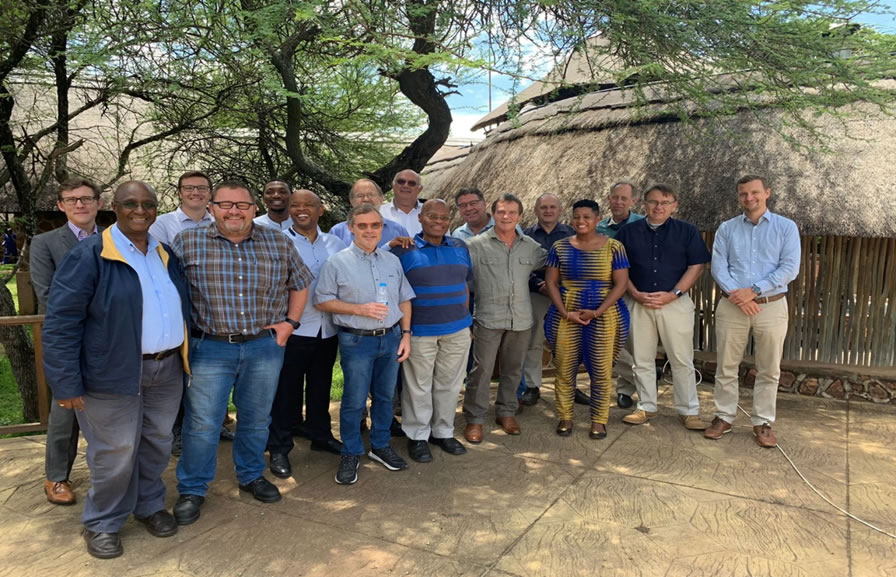
Delegates at the Kwa Ndaba Bosberaad. Piet le Roux; Barney Pityana; Werner Human; Kallie Kriel; Lukhanyo Neer; Max Boqwana; Koos Malan; Flip Buys; Theo de Jager; Thozamile Botha; Chris Opperman; Theuns Eloff; Dirk Hermann; Lebogang Chaka; Carel Boshoff; Willie Spies; Hermann Suhr (Konrad Adenauer Stiftung)
During the conference, recognition was given to the fact that the Afrikaner community is a “true collective” and that the cultural energy of Afrikaners and their ability to organise and create economic prosperity could be an important impetus for development and growth that could benefit all Africans. The articles in the South African constitution that allow for cultural expression were never truly implemented, especially articles 1, 2, 3, 6 as well as 29, 30, 31 en 25, as well as article 235.
The Conference also dealt with the Afrikaner’s sense of growing alienation and ways in which this could be addressed by way of the recognition of cultural spaces for Afrikaners and to involve Afrikaners in the contribution towards economic spaces where the economic conditions for growth and massive job creation for all could be agreed upon.
It is important to mention here that a lot of planning and new thinking characterised preparations in anticipation of the Conference. What do we want, and how will we achieve our aims? It became important that we sign a declaration at the Conference, and two broad concepts became evident, namely, the contribution Afrikaners can make to the development of South Africa and Africa and a common future, through the development of “Special Economic Zones” and also the creation of cultural spaces for the preservation of the Afrikaner’s culture, coined “Special Cultural Zones”. Please find a Politicsweb article written by Prof Pierre du Toit, who assisted with the strategic thinking underlying preparations for the Conference.
We thought that the Conference would take the form of simulated negotiations, but we decided to meet for an Indaba (Bosberaad) at Kwa-Ndaba so that we could thrash out the principles of cooperation, and that the conference in Cape Town would put a stamp of approval on the deliberations and agreements reached at Kwa-Ndaba. The principles found their way into the adoption of the Kwa-Ndaba minute. Twelve Afrikaner delegates and eight Mbeki delegates locked horns, and discussed and debated late into the night, but the breakthrough was made early the next morning when a consensus had developed. The Kwa-Ndaba minute penned the consensus into a concept that was eventually adopted with a few alterations in Cape Town and is now known as the Joint Declaration.
An important aspect of the AAI’s mission is to create opportunities to talk about and understand the deep hurt and anger caused by racial oppression and the inequalities of the past. Afrikaners are involved in discussions, seminars, and workshops to explore painful themes of the past with fellow South Africans, and solid foundations for new understandings and friendships are built. We will also reach out to communities in other countries in Africa with contact tours and visits. We will also study how minorities are accommodated in other parts of the world. We are fortunate to be supported by the Konrad Adenauer Foundation, which will fund these activities.
It is important to note that a broad cross-section of organisations have positively reacted to the formation of the AAI, and op-eds from different opinion leaders should be mentioned.