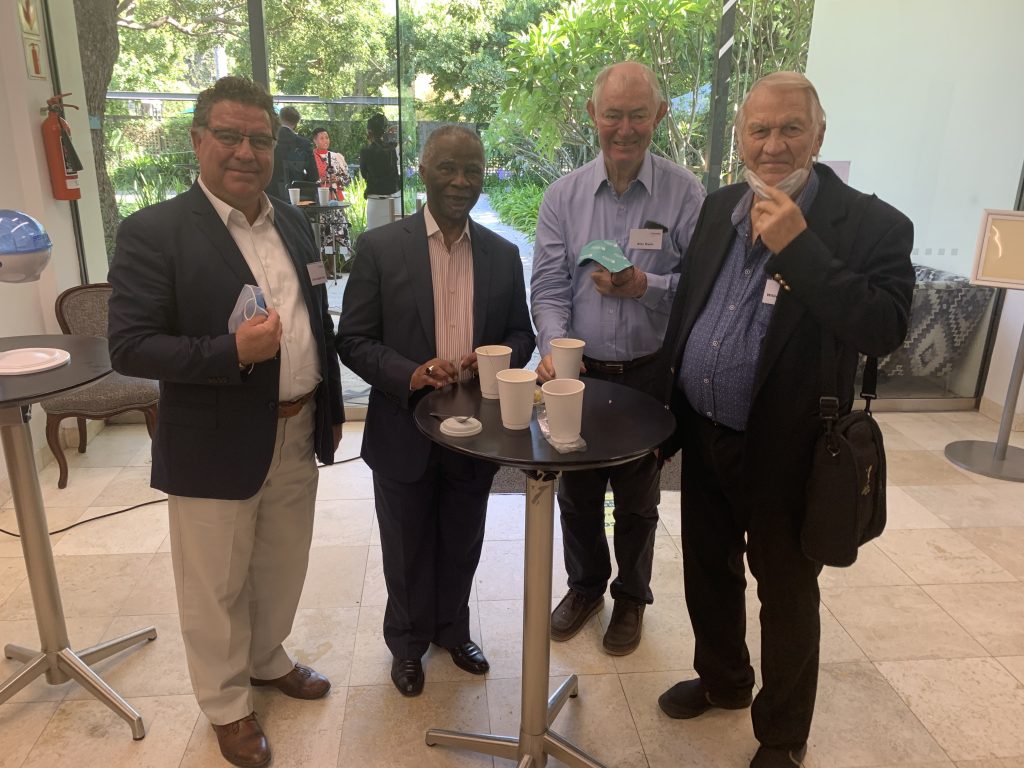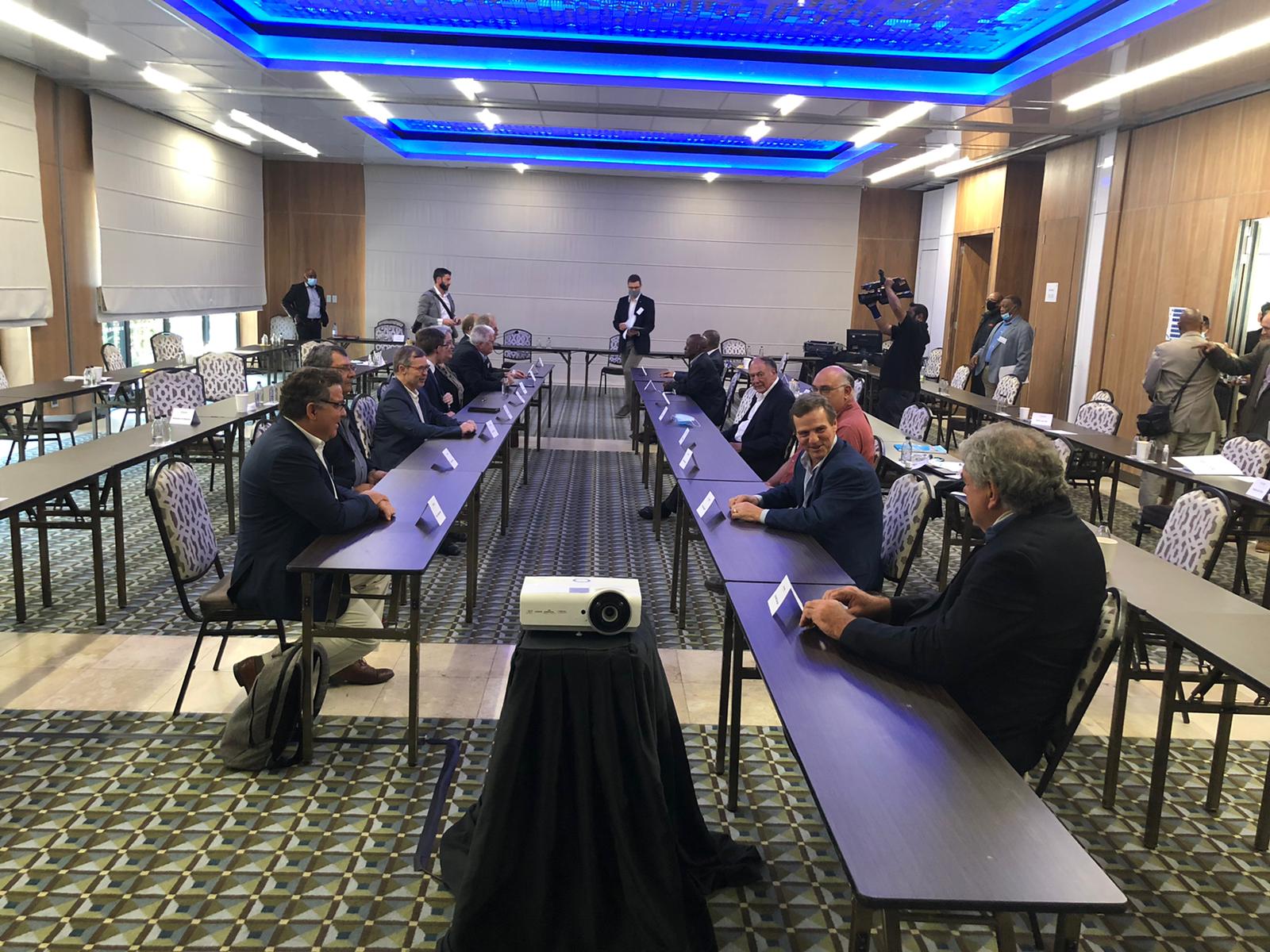
The Delegates sign the Joint Declaration on 27 February 2021: fltr: Chris Opperman; Pieter Vorster; Koos Malan; Piet le Roux; Irma Eloff; Gerhard Papenfus; Dirk Hermann; Carel Boshoff; Flip Buys; Thabo Mbeki; Vincent Maphai; Oppel Greeff; Theo de Jager; Theuns Eloff; Schalk Burger
The Joint Decelaration in Cape Town was signed by the following organisations and individuals:
- Thabo Mbeki Foundation :- Dr TV Maphai. Please find a Litnet Podcast between Freek Robinson and Dr V Maphai
- The Solidarity Movement:– Flip Buys
- AfriForum:-Kallie Kriel
- Federasie van Afrikaanse Kultuurvereniginge (FAK) :– Prof. Koos Malan
- The Afrikanerbond:-Dr. Pieter Vorster
- Solidariteit Trade Union:– Dr. Dirk Hermann
- The DagbreekTrust:– Dr. Theuns Eloff
- Suid-Afrikaanse Akademie vir Wetenskap en Kuns:- Prof Oppel Greeff
- Sakeliga:– Piet le Roux
- The Vryheidstigting:– Carel Boshoff
- Southern African Agri-Initiative (SAAI):- Theo de Jager
- National Employers Association of South Africa (NEASA):- Gerhard Papenfus
- Afrikaner-Afrika Inisiative:- Chris Opperman
- Schalk Burger (wine farmer and ex-Rugby Springbok)
- Dr. Irma Eloff (Leader in Education circles)
The Joint Declaration represents an agreement on the following themes, priorities, and projects, and the spirit of the agreement can be summarised by the Nguni word vuk-uzenzele, or, do it yourself: Here is a link to the text of the Joint Declaration.
- Desire to create an inclusive economy to deal with mass poverty by the removal of red tape and restrictive policies that jeopardise economic growth and job creation.
- Financing of agriculture for new entrants, and for current producers.
- Promotion of agriculture to ensure food security and mass employment.
- Promotion of indigenous languages from neglect to modern languages. The parties will promote indigenous language tuition at schools and universities and will work together to resurrect the Lovedale Press in Alice, and the CP Hoogenhout Skool in Wellington.
- Non-discrimiation in education. The importance of mother tongue education and autonomy for communities in managing their schools.
- Addressing the trust deficit and feeling of alienation between the Afrikaner community and the Government.
- Inclusion of minorities in the political life of South Africa. How do communities such as the Afrikaner community participate and have a voice at the central government level?
- Municipal infrastructure and improved local government participation. Exploring new mechanisms to improve local government and service delivery through community participation.
- The promotion of safety and security and also security in rural areas.
- Indigenous African communities such as the Afrikaners’ equal treatment in preserving their art, prose, poetry, music, history, monuments, and the recognition of traditional communal areas for all indigenous communities.
To give effect to the principles contained in the Joint Declaration, a new structure has been created in the wake of the Cape Town Conference. The structure is based on the idea of a Joint Venture between the Thabo Mbeki Foundation and the Afrikaner Organisations. The Structure will be as follows:
- Oversight Committee:
The oversight committee consists of the organisations that signed the Joint Declaration. Twelve Afrikaner organisations are represented there, and the Thabo Mbeki Foundation can nominate twelve members to the committee as well. They will meet two to three times per year. Dr. Vincent Maphai and Dr.Theuns Eloff are the two Co-Chairs.
- Steering Committee:
The steering committee consists of five Afrikaners and five persons representing the Thabo Mbeki Foundation. The Afrikaners are Flip Buys, Kallie Kriel, Werner Human, Theo de Jager and Schalk Burger. The members of the Thabo Mbeki Foundation are Max Boqwana; Lebogang Chaka, Lukhanyo Neer; Thozamile Botha and Prof Seth Phalatse.
- Coordinator:
At the first meeting of the Oversight Committee, Chris Opperman was unanimously appointed as coordinator.
Chris Opperman worked in various capacities in the Department of Foreign Affairs as a Diplomat for South Africa, and later in the private sector. He participated in diplomatic initiatives as a young diplomat during South Africa’s transition to democracy in Washington DC and in Dar es Salaam, Tanzania. As a businessperson, he excelled in setting up new ventures in Africa, including the first Medical Insurance company in East Africa, Med-X, and as Country Director of the Oil and Gas Exploration Company called Rakgas Tanzania, he founded the Oil and Gas Association of Tanzania and helped new revenue streams for the country. His focus on the people and communities of Tanzania, on the development of schools, electricity supply, and water wells to communities where the company operated, yielded a strong return on investment for the company, as well as its local public and private partners. These efforts brought real, tangible benefits to the people of Tanzania. He also worked on a special project to promote investments from the United States and South Africa to Tanzania, which led to various new ventures being established, the most notable being an investment by Seacom, a marine fiber optic cable operator, which built a new cable around the East African coast.
In 2015, Chris Opperman spearheaded efforts to establish a new strategic dialogue program between the Afrikaner Community and other African communities, in conjunction with the Thabo Mbeki Foundation. The series of strategic dialogues developed into the Afrikaner-Africa Initiative, aimed at involving leaders in civil society, the private sector, and government in a new effort to develop cooperation and discussion between communities about the future of South Africa and of Africa.
Chris is a proponent of the idea that Africans should take charge of their own future and the future of an Africa that is truly prosperous and free. He currently coordinates the Afrikaner-Africa Initiative to establish a dialogue between Afrikaners and fellow Africans.
- Project Committees:
The following project committees have been constituted with the following coordinators:
- Desire to create an inclusive economy to deal with mass poverty. (Special Economic Zones): Piet le Roux; Lebogang Chaka.
- Financing for agriculture for new entrants and sustaining producers. Theo de Jager; Lukhanyo Neer.
- Promotion of agriculture to ensure food security. Theo de Jager; Lukhanyo Neer
- Promotion of Indigenous Languages and autonomy in school governance. Theuns Eloff; Dr Athambile Masola.
- CP Hoogenhout School and Lovedale Press. Dirk Hermann; Schalk Burger; Lukhanyo Neer.
- Municipal Infrastructure and creation of functional local government. Kallie Kriel; Thozamile Botha.
- Indigenous African community.
- Promotion and preservation of cultural spaces for all communities.
- The trust deficit between the Afrikaner and government – minority rights.
- Political inclusion of minorities. TV Maphai; Dirk Hermann.
- International awareness (Embassies and International organizations). Chris Opperman; Max Boqwana..